Real airline fleet ordering is one of the most consequential strategic processes in the industry, and it doesn’t look anything like the dropdown most airline sims give you. You don’t “click to buy an A320.” You compete for a production slot two years out, negotiate price with a relationship manager who’s tracking your order history, pick a financing structure that you’ll be living with for the next decade, then sit down and lay out the cabin you actually want.
We wanted SkylineSim to put you inside that whole sequence instead of abstracting around it. Below is what we built, walked through one A321neo order from the catalog to the cabin.
(If you want a complementary read, how airport slots work covers the other side of fleet operations, the runway-time permission that decides whether the aircraft you just ordered can actually fly the route you want it for.)
Production slots are a market
Manufacturers have real capacity. The A321neo line we model for the 2019 scenario builds about 50 aircraft a quarter, split across Hamburg, Toulouse, Mobile, and Tianjin. A350-900s come off the line at 15 a quarter. ATR 72s at 6.
That capacity isn’t sitting there waiting for you. When a scenario opens, the order book is already partially full of historical orders. American, Lufthansa, IndiGo, and the LCC buyers locked in their A321neo positions years ago, with firm orders and options layered onto the right years. So when you browse the catalog, you’re looking at what’s left.
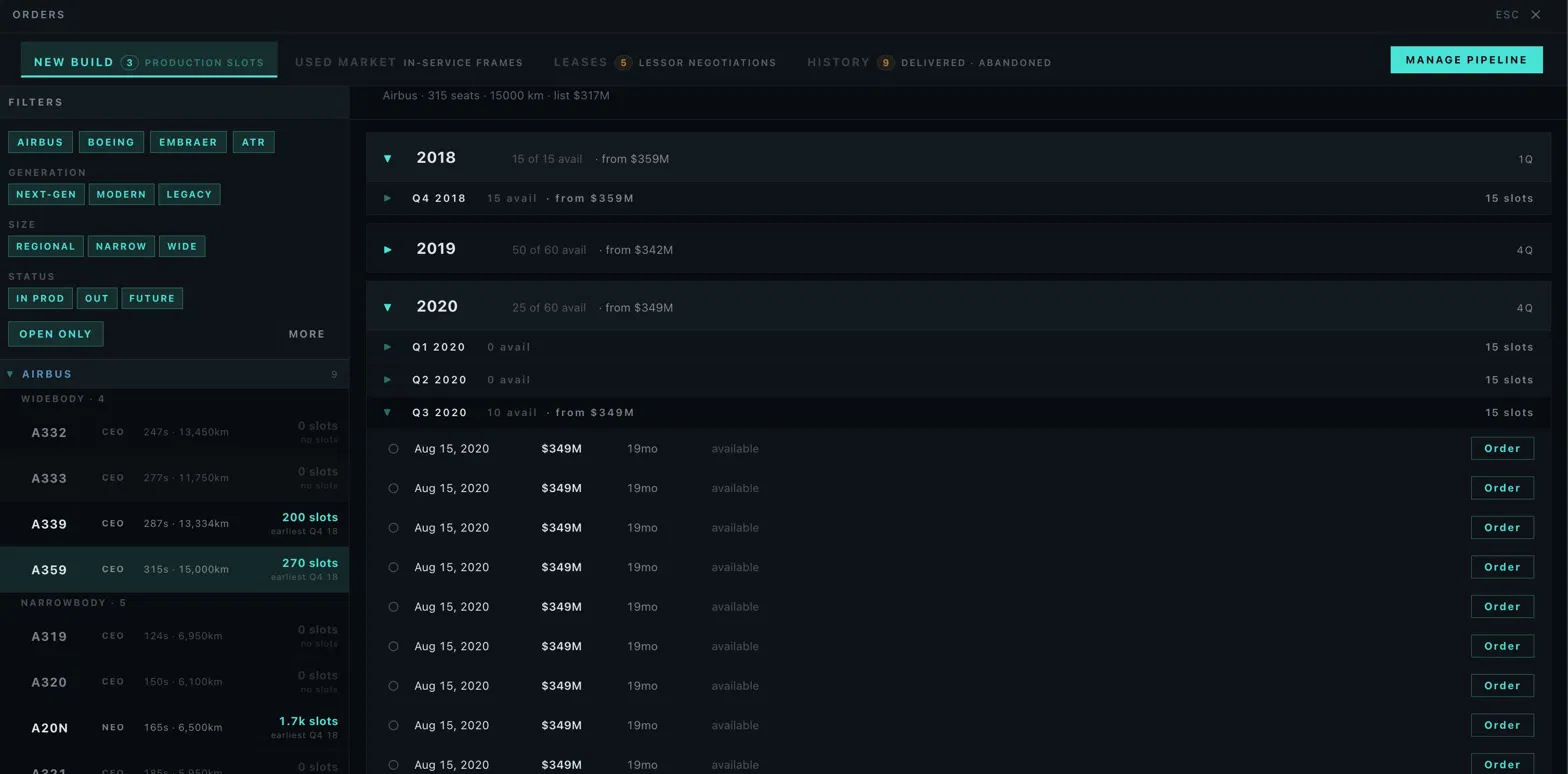
We aggregate the view by year first because that’s how fleet planners actually think. The A21N in 2019 shows 70 of 70 slots open. 2020 has dropped to 110 of 160 because the AI competitors have been busy, and Q1 2020 is already gone entirely.
Drill into a year and you see quarter-by-quarter. Drill again and you see individual slots. Q2 2020 has 30 left, each delivering between April 24 and the middle of May, each at €133.0M with 8 to 9 months of lead time.
Watch the spread between list price and slot price. Airbus’s published A21N list is €117.2M. The slots in the catalog are €133.0M, +13%. That’s not a glitch, it’s scarcity. When demand for a production year exceeds supply, the slots clear above list. When supply opens up (a major airline cancels, or capacity ramps), the spread inverts and slots clear below list. The number you see at the slot level reflects where the market actually is, not where the manufacturer wishes it were.
The filters do what you’d expect: manufacturer, generation, size class, production status. “Next-gen narrowbodies that are still in production” narrows the catalog to the aircraft you can realistically buy today.
You’re not the only buyer
Every January, the AI airlines run their own fleet planning pass. They look at their network growth, demand forecasts, and cash position, and they claim slots from the same order book you’re working from.
We cap their claims at 60% per (manufacturer, type, year) so the player always has room. The AI tends to bid on far-future slots two to five years out, which leaves decent near-term inventory if you move quickly. Players who option early and convert later tend to do well. Players who drag their feet open the catalog one January and find every 2019 A21N already gone.
Scarcity matters here. A 2019 A21N is still €133.0M with 70 of 70 open at scenario start, but wait a year and you might be looking at a higher price, a later delivery, or a compromise aircraft.
Negotiation is a real conversation
Once you’ve locked a slot, you negotiate price.
It’s not a slider. It’s a turn-based back-and-forth with a specific person on the other side, and where you land depends on the manufacturer’s attitude toward you, how many orders you’ve placed before, where the market is, and how many airframes you’re buying.
Manufacturers fall into one of four moods: Strategic, Cooperative, Aggressive, Dismissive. A first-time customer at Airbus is a different conversation from an airline with 15 orders under its belt. Boom markets give the manufacturer less reason to flex. Recessions open them up.
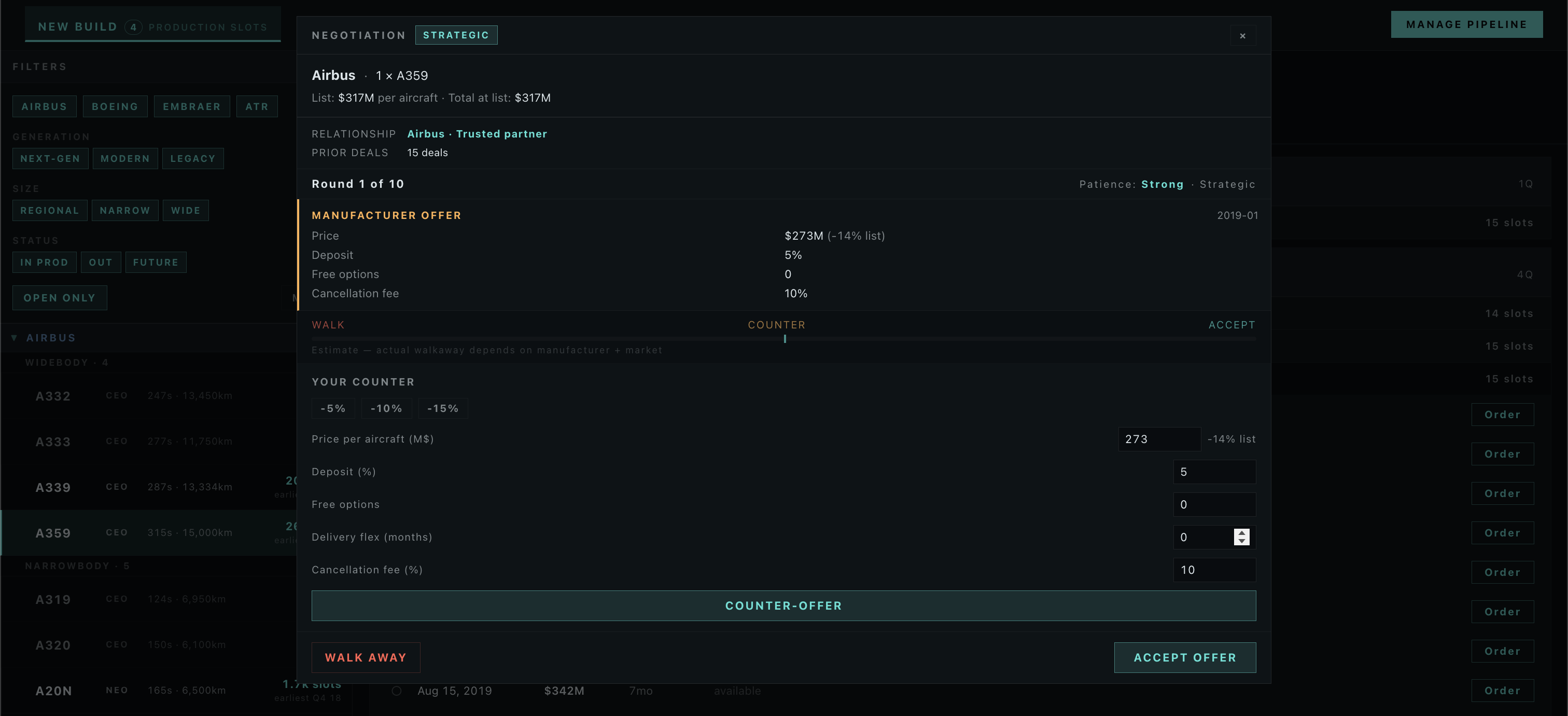
The screenshot above is a Round 1 opening from Sven Müller, Airbus’s Strategic-tier relationship manager out of Hamburg. The player has 32 prior orders on the book, which is why Sven is engaged and patient: trust is 85 out of 100, his patience meter is full, and his opener is already 14% off list at €101.2M. The “Where does this offer sit?” guidance is honest about it, the typical outcome range for a player with this relationship is €103.8M to €116.7M, and Sven’s already below that floor. You can push, but you’re shaving the last few million off an already favorable deal.
A live negotiation runs in rounds. Each round costs the manufacturer some patience. How much patience they have to start with depends on their type and your relationship history. Strategic partners stay at the table. Dismissive ones walk if you push hard. You see the offer, you see how patient they still are, and you see a form with five things you can push on: price, deposit, free options, delivery flex, cancellation fee.
If you want to move fast, there are quick-counter buttons at -5%, -10%, and -15%. If you want to take the deal and move on, accept and you’re at financing in the next step.
You can also skip negotiation entirely and pay list. We won’t stop you. But 14% off a €117.2M aircraft is real money, and players who skip on every order leave hundreds of millions behind across a long save.
Financing options
Once the price is locked, you decide how to pay.
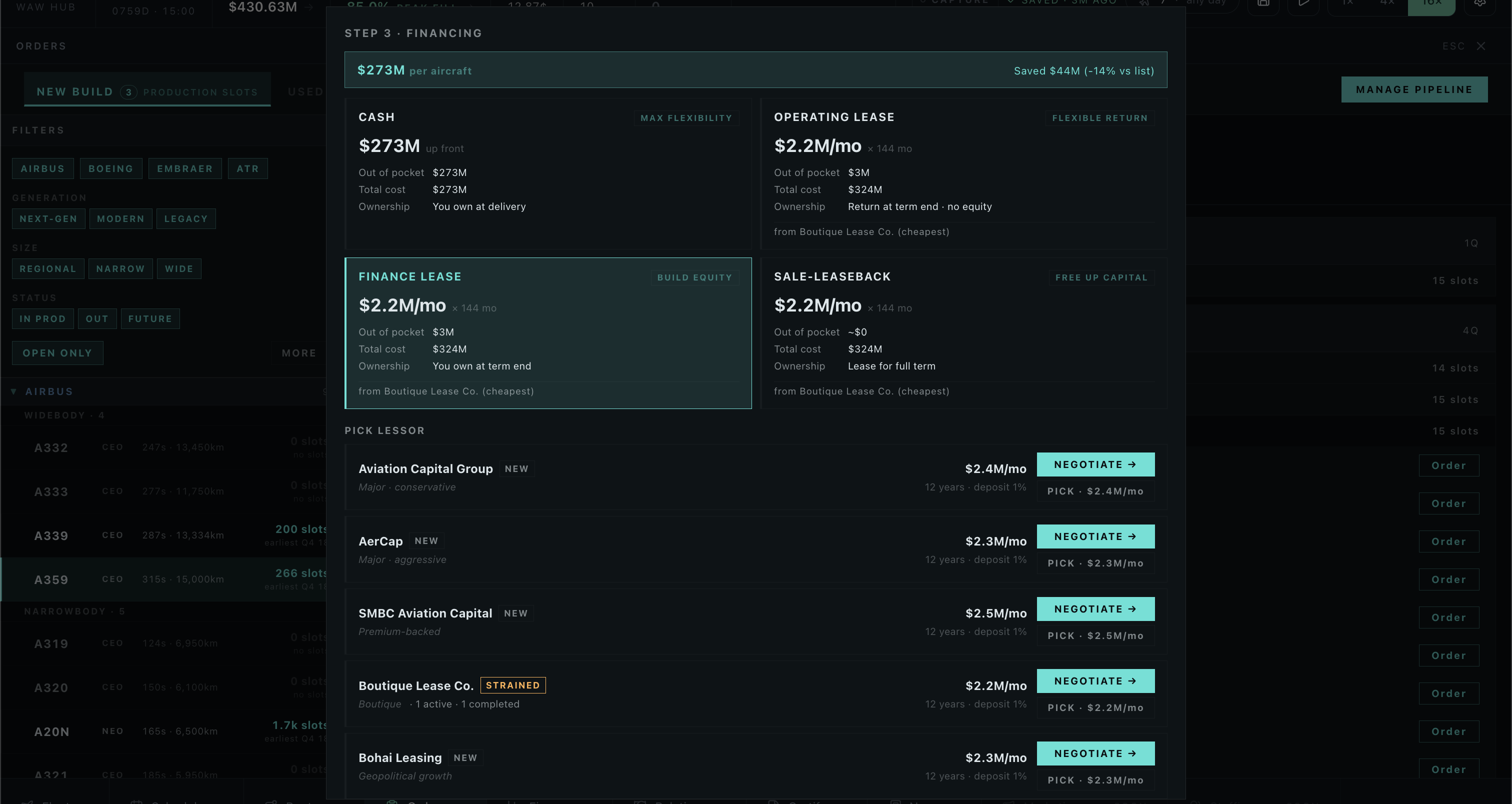
In the real world, financing isn’t a checkout step. It’s arguably the most important strategic decision after the order itself. More than half the global commercial fleet is on operating lease. Delta and United run sophisticated capital structures across cash, debt, and leases. Capital efficiency tends to matter more than absolute cost.
We tried to make that real. The four paths on the screen each map to a different philosophy:
Cash is for the airlines that can afford to act like Emirates. Pay €101.2M up front, own the aircraft, no monthly commitments, no counterparty to worry about. The cost is what you can’t do with that €101.2M afterward: new routes, hub investment, growth.
Finance Lease is the slow build. €760k a month for 180 months, with €1.2M down and €137.0M total over the term. At the end, the aircraft is yours. You’re trading a 15-year cash commitment for ownership equity, and you’re carrying that commitment through whatever downturn shows up.
Operating Lease is what most modern airlines actually run. €826k a month for 144 months, but at the end you hand the aircraft back. You’re paying for flexibility. When the market shifts, you’re not stuck with residual value risk. Ryanair and Wizz Air run lease-heavy fleets for exactly this reason. In this deal it’s €120.0M total, about €18.8M of premium over Cash for the optionality.
Sale-Leaseback is a capital trick. You buy the aircraft, immediately sell it to a lessor at near book value, and lease it back. Net cash impact is roughly zero at signing, the asset is off your balance sheet, and you’re paying €876k a month for 36 months, €45.0M total, to keep using it. Airlines use this when cash gets tight or leverage needs to be restructured.
Behind those four paths sits the lessor market. In reality, about five major players own most of the world’s commercial aircraft. We mirrored that with five archetypes:
- Aviation Capital Group (Major, conservative): big book, careful underwriting, less willing to budge
- AerCap (Major, aggressive): the biggest real-world lessor, willing to deal for volume
- SMBC Aviation Capital (Premium-backed): bank-backed, premium pricing, solid terms
- Boutique Lease Co. (Boutique): small player, willing to compete on price for portfolio diversity
- Bohai Leasing (Emerging-market growth): emerging-market backing, geopolitically flexible
Same aircraft, different rates. AerCap might quote €870k a month, SMBC €920k, on identical airframes and identical 12-year terms. That spread compounds. An airline running 30 leased aircraft with the wrong lessor can be burning €25M+ a year extra for no real reason. In the screenshot above, Boutique Lease Co. happens to be the cheapest available across every option, that won’t always be true.
You can take a lessor’s quoted terms, or open a negotiation against them. Same turn-by-turn system, just with the lessor on the other side. Successful deals build trust. Burning a lessor in a negotiation costs you on the next quote.
Where it really gets interesting is lease return. Every operating lease has a return condition floor, usually “good.” When the term ends, we check the aircraft’s actual state against that floor. Hours flown, cycle count, maintenance history, physical condition. Come in under and you eat redelivery costs, roughly 4% of list price per condition step below floor. Return early and the lessor remembers.
This is where the choices you made while operating the aircraft start mattering financially. Fly the lease hard, defer maintenance, push utilization past design parameters, and the redelivery bill at term end is going to hurt. Maintain it carefully and you get most of your security deposit back. The financing decision you made up front only looked cheap if the operational decisions downstream actually supported it.
There are two more financing paths sitting in the engine that we haven’t shipped to the UI yet. Enhanced Equipment Trust Certificates, the dominant capital-markets instrument for US carriers, basically tranched secured debt backed by aircraft. And Export Credit, government-backed financing from the manufacturer’s home country, used heavily by international carriers buying Boeing or Airbus. Both will land in a later update with their own counterparties.
Configuring the cabin like a real airline
This is the part where SkylineSim goes somewhere most sims don’t.
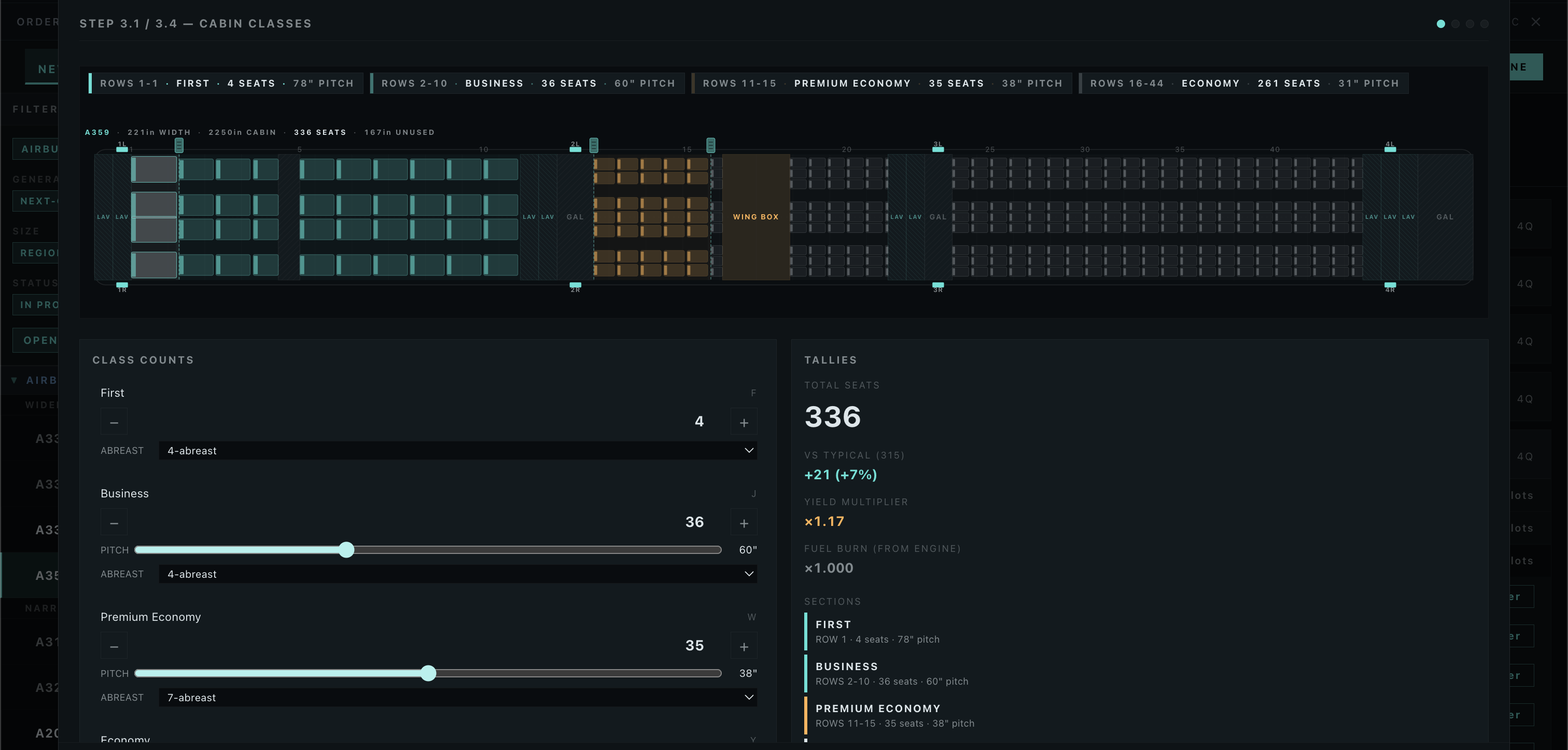
The Cabin step puts your A21N on a real fuselage. 144 inches wide. A legacy-standard two-class config lays out 172 seats: 28 Business at 60-inch pitch and 144 Economy at 30-inch pitch. The Tallies panel reports this is 28 seats less than a typical A21N config (-14%), with a yield multiplier of ×1.16 because of the heavier premium share, and no fuel burn penalty over the baseline engine option.
The seat map shows what matters operationally:
- Doors at the right fuselage positions (1L/1R, 2L/2R, 3L/3R, 4L/4R)
- Galleys at the front, middle (over the wing root), and rear of the cabin
- The wing box as a structural constraint mid-cabin where seats can’t go
- Class boundaries computed from your mix and pitch (Business takes rows 1-7, Economy 8-31)
- Abreast variation per class: 4-abreast in Business, 6-abreast in Economy
Change the class counts and the seat map redraws. Push pitch up or down and rows expand or contract. The Tallies panel shows the impact in real time: total seats, deviation from typical configuration, yield multiplier, fuel burn delta.
If you don’t want to do this yourself, hit one of the factory presets, ULCC Standard, Legacy Standard (14% J), Long-haul Y-heavy, Premium Leisure, and we apply defaults tuned to your brand archetype. The screenshot above shows the player landing on Legacy Standard, and the Tallies confirm it’s a strong fit (5 out of 5) for the brand. We’re not going to make you build seat maps if you don’t want to. But if you want a high-density LCC layout or a premium-heavy long-haul, the tools are here.
The next sub-steps (3.2 through 3.4) cover engine variant selection (each with its own fuel burn and maintenance modifiers), ETOPS certification, and crew rest provisions for long-haul.
What it adds up to
You place the order. Cash leaves your account. The aircraft enters your delivery pipeline. Eight months later, or however far out the slot was, the airframe shows up at your hub ready to fly its first rotation.
Now do that 20 to 100 times across a 10-year campaign. The decisions compound:
- The manufacturers you build relationships with shape every future negotiation (Sven Müller doesn’t forget the airlines that burned him)
- The financing mix you pick shows up in your cash flow and balance sheet for years
- The configurations you choose determine yield and route eligibility
- The timing of your orders decides whether you fight for slots or have your pick
Real fleet planners agonize over this stuff. We wanted players to have the same surface to push on, because the choices are interesting in a way most sims don’t let them be.
SkylineSim is in development. We’re aiming for early access in 2027.
If this is your kind of sim, the Discord is where the build gets shared first: discord.gg/HsqucsgsGd
You can also sign up for the newsletter at skylinesim.app.
For comparisons against the existing options in the genre, see the AirlineSim alternative breakdown and the broader single-player airline simulator landscape.
the skyline team