This is the third post in Road to playtest, our short series on the systems we are hardening before founding members get the release/1.0.0-playtest build on 17 July. Post #1 covered Brand, post #2 covered Crew. This one is about the single biggest rebuild since we announced the date: manufacturers.
Until now, the manufacturer side of Skyline was a CRM read-out. You had a trust number, a tier badge, and a queue-position diagram that implied your standing mattered. Under the hood, production slots were handed out by alphabetical airline ID. The relationship looked like a mechanic and behaved like wallpaper.
That is gone. On the playtest build, Airbus is a company. It launches programmes, runs production lines, suffers strikes, promotes executives, books rival mega-orders, and if you have earned it, invites you to Toulouse. Your standing with a manufacturer now decides, mechanically and deterministically, which delivery slots you can physically reach. The screenshots below are pulled from the playtest branch. Same UI that ships on 17 July.
The living world
Every OEM in the game (Airbus, Boeing, Embraer, ATR, Bombardier, McDonnell Douglas, Fokker, De Havilland Canada, BAe) now carries its own simulated state, ticked monthly alongside the rest of the world.
Programmes have a lifecycle. Every aircraft family moves through announced → development → testing → ramp → mature → sunset, driven by the real historical masters (first delivery year, last production year) plus simulated deviations. A programme can slip. A pre-EIS type only shows up in the catalog once the world has actually announced it, so you can no longer order an aircraft that does not exist yet.
Production lines are real. Each family runs a line with a monthly rate, an order backlog in frames (yours and the AI carriers’), and a derived next-open-slot date. Hot lines have backlogs stretching years out. Cold lines can take you next quarter.
Things happen. A deterministic monthly event roll per OEM produces strikes (with transient rate cuts on the affected families), certification milestones, rate changes, factory expansions, executive moves, and programme slips. Rival mega-orders are not rolled. They are read straight from the AI order book, because the AI carriers genuinely place them.
Consequences propagate. A strike cuts the line rate, the backlog recounts, your inbound delivery ETAs slip, and the slip surfaces as an alert in your delivery book and as a story in the News feed. Nothing is cosmetic anymore.
And it is all deterministic. Same seed, same strikes, same slips, same invitations. Replays stay byte-identical, the same discipline as every other engine system.
The manufacturers workstation
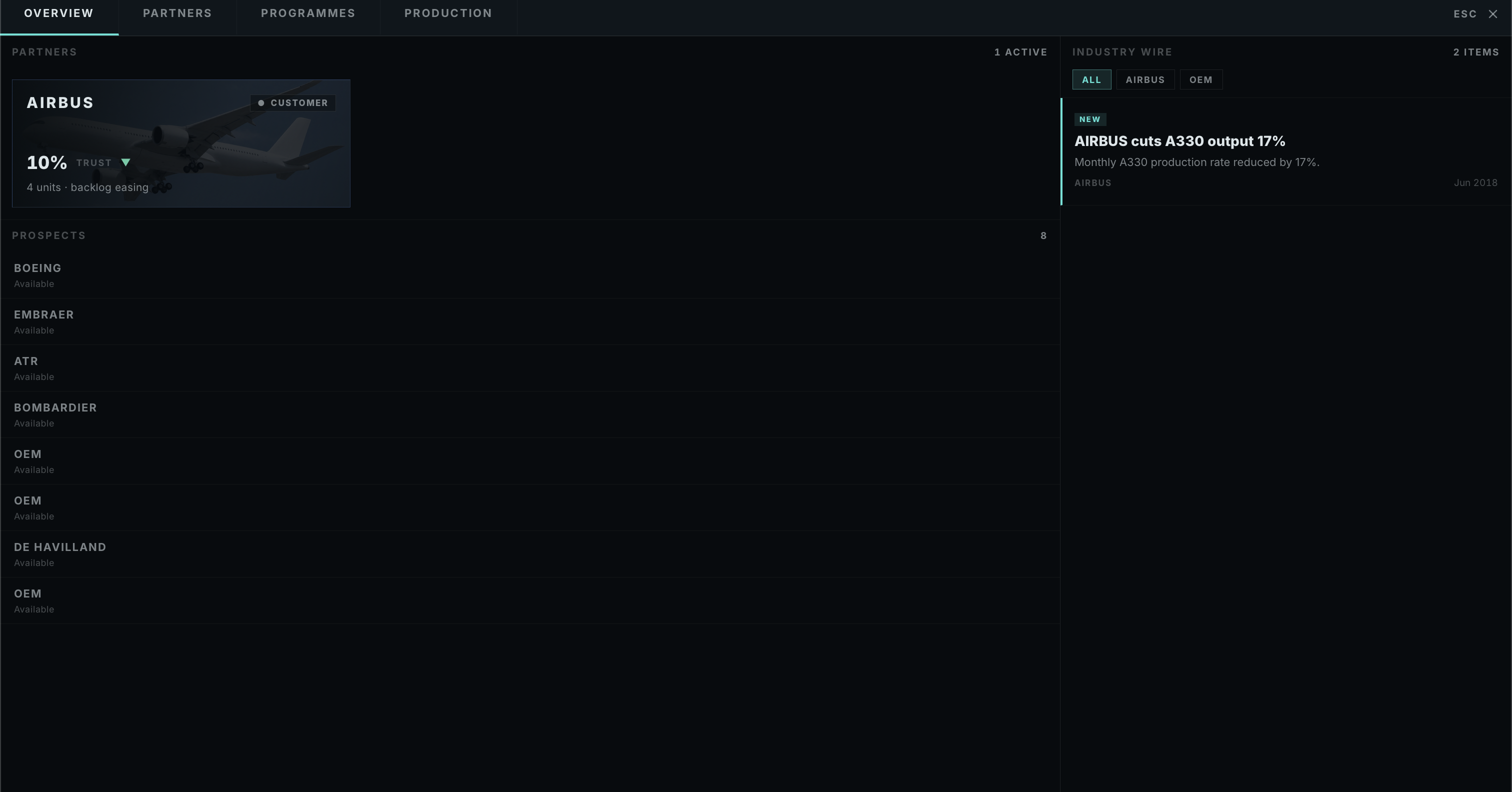
The entire old manufacturer surface (the profile screen, the relationship tabs, the strategic-partnerships page) was deleted and rebuilt as a single photographic OCC workstation in the Brand/Crew register. Four tabs:
| Tab | What you do there |
|---|---|
| OVERVIEW | Read the industry floor: partner wall, urgent strip, and the live industry wire |
| PARTNERS | Work a relationship: the rep dossier, your standing, your history, and the deal desk |
| PROGRAMMES | Read the living atlas: lifecycle bands, EIS countdowns, variant personalities, your exposure |
| PRODUCTION | Read lines and backlog: rates, frontiers, and your delivery book |
OVERVIEW · the industry floor
One hero-photo card per manufacturer you have a relationship with: wordmark, tier chip, trust, backlog pulse, one-line status. An urgent strip at the top surfaces pending invitations, expiring options, delayed deliveries, and active negotiations, each deep-linking to the right tab. On the right, the wire: a reverse-chronological industry feed of everything the OEM world is doing, filterable per manufacturer, with the freshest story leading as a headline and the newest month flagged. Trust reads as a plain percentage, stated once. No engine internals on the surface.
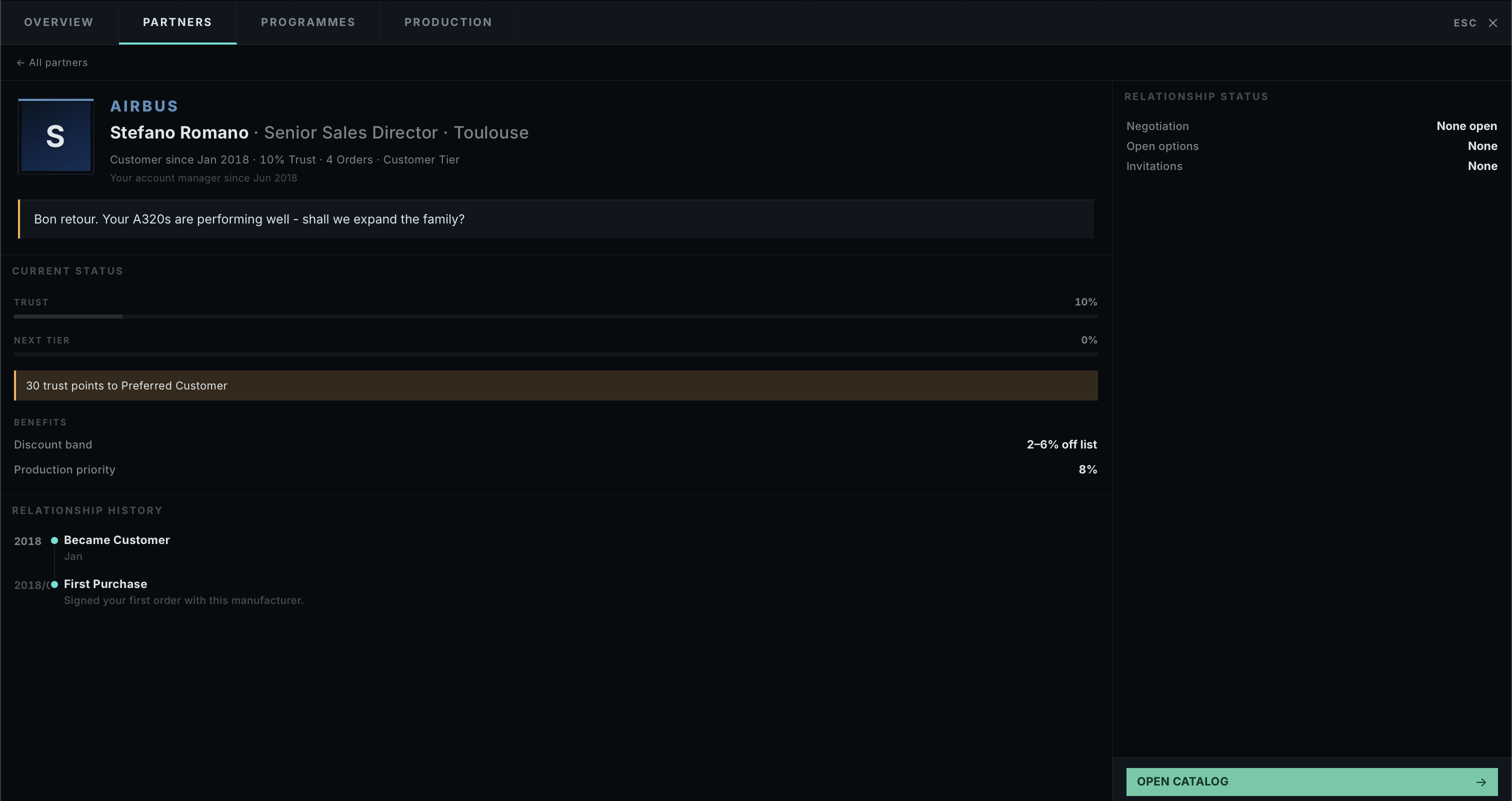
PARTNERS · the relationship dossier
Pick a manufacturer and the screen becomes a confidential account file, not a stats page. The hero is one identity block: manufacturer wordmark, a named relationship manager over a monogram, their role and tenure, and a single fact line (customer since · trust · orders · tier). Under it, the rep’s latest message, written in their own words as a quoted communication, not a notification banner. Then current status as one module: a trust rail, a next-tier rail, the exact thing blocking your climb (“30 trust points to Preferred Customer”), and the benefits your tier already banks (discount band, production priority). Then your relationship history as a real vertical timeline: first order, tier changes, closed deals, milestones. The right pane is one compact deal desk: a tight status summary that expands into actions only when there is something to do, whether that is resuming a negotiation, firming up or releasing an option, or accepting or declining an invitation, anchored by a single primary button that deep-links into the Orders catalog filtered to this OEM. Lessors open in the same flow, below a divider.
PROGRAMMES · the living atlas
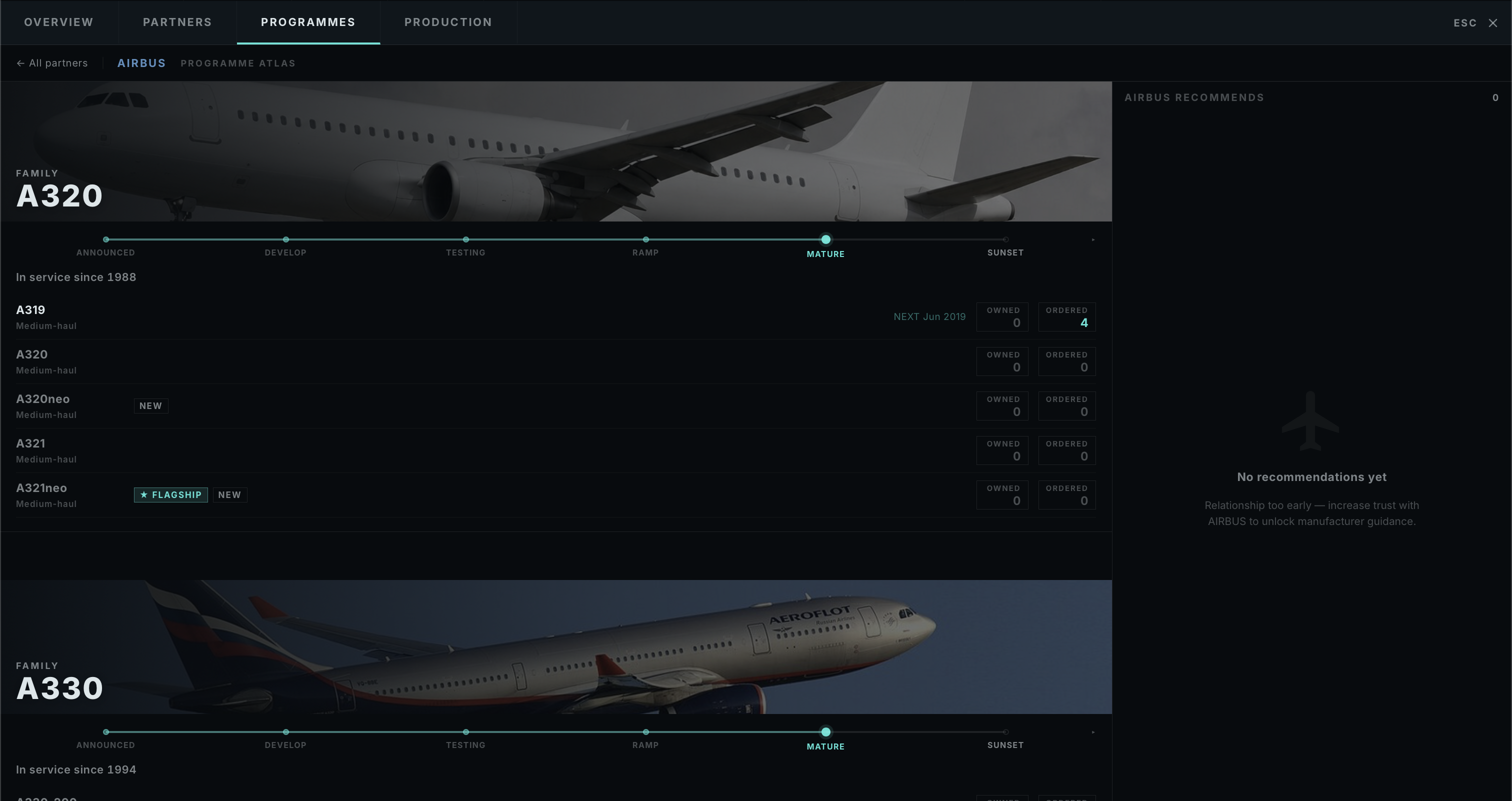
Per-family programme sections: a poster-scale family header, photo hero, a lifecycle band read as a timeline (announced through sunset, with the current phase marked), and an EIS countdown spelled out (“EIS in 26 months · Sep 2028”) or a sunset horizon. The variant ledger gives each aircraft personality: a haul descriptor, FLAGSHIP / NEW / XLR / freighter marks, and owned and ordered chips. Hovering a row reveals its full spec (seats, range, MTOW, first flight, list price) without leaving the page. Out-of-production types collapse into their own section. A variant only appears once it is genuinely near service, so a 2018 game never lists a frame that first flies in 2024, and family classification is honest: a long-legged A320 is still short and medium-haul, not “long-haul”. The right pane is “{Manufacturer} recommends”: two or three recommendation lines derived from your actual fleet (aging frames pointing to an in-production successor, bands you fly but do not own, family-commonality wins), each deep-linking into the deal desk. When a relationship is too young to advise, the panel says so rather than sitting empty.
PRODUCTION · lines and backlog
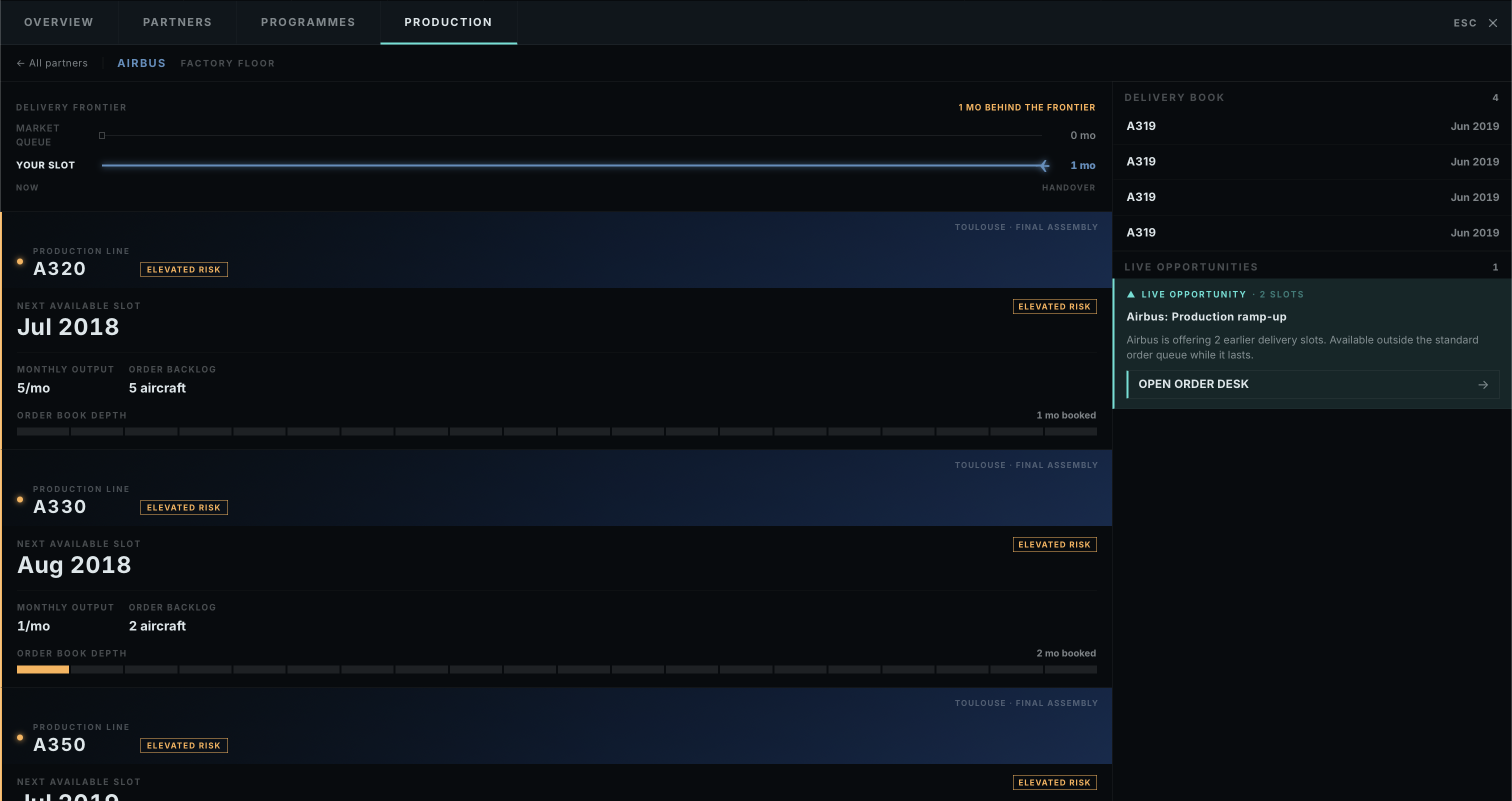
One section per production line: factory photo, current rate, backlog sparkline, the next-open-slot frontier, and a delay-risk flag when the line is degraded. The right pane is your delivery book: inbound units, ETAs, slip alerts, plus live delivery opportunities with their claim actions.
Standing is real now: relationship-ranked slot allocation
This is the deepest change, and it is engine-side.
Production slots were always a genuinely shared finite pool. 39 AI airlines claim from the same order book you do. But who got the early slots was decided by sorted airline ID. Your Flagship Operator tier bought you nothing at allocation time.
Now every carrier, player and AI, has a unified standing score (0..1) per manufacturer. Yours comes from the full relationship model: trust, tier, fleet with that OEM, order volume, relationship memory. The AI’s comes from a mirrored proxy: fleet-with-manufacturer, order tenure, volume. Everyone ranks on the same axis.
The order book exposes a backlog frontier, the earliest still-available slot on each line. Slots near the frontier form a premium band: the earliest slot needs standing near 1.0 to reach, decaying smoothly deeper into the queue until anyone can claim. The band width scales with the line’s production rate, so a hot high-volume line has a wide contested early region and a cold line is open access.
What this means in play:
- A 15-year all-Airbus operator reaches A320neo slots a startup cannot. That applies to AI carriers too. Every January, the AI ordering pass now claims slots in standing order, not ID order.
- You are never hard-denied. Low standing does not block the order. It lands you deeper in the queue and later on the calendar. Delivery date now falls directly out of standing times line contention.
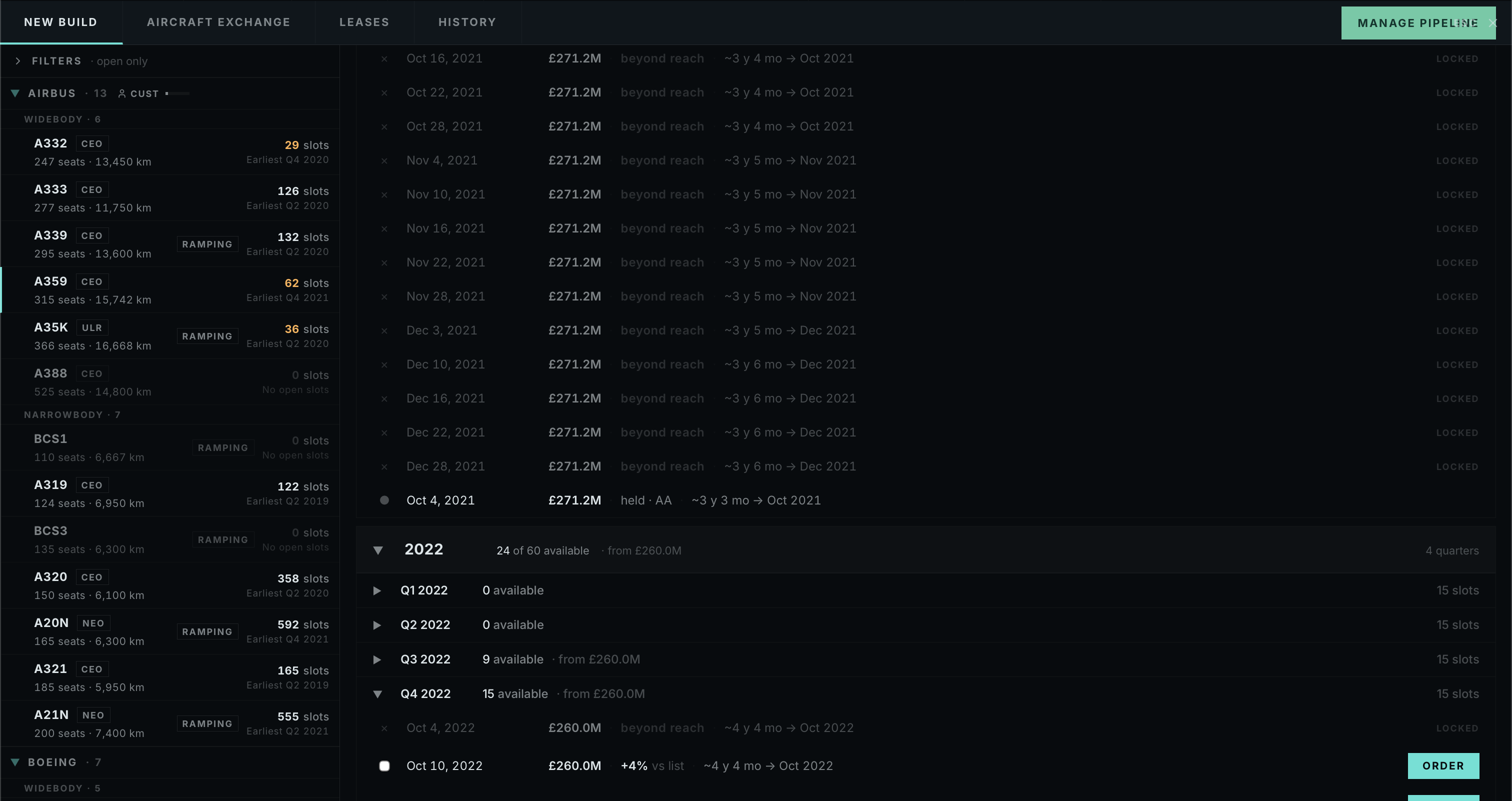
- Locked slots are visible. The Orders timeline draws the frontier and renders premium-band slots as visible-but-locked, each marked “beyond reach” with the lead time it would still cost, so you can see exactly what a better relationship would buy.
- Benefits fold in mechanically. Free options and negotiated pull-ins act as additive standing bumps. They let you reach further into the premium band instead of being flavor text.
- There is a physical minimum lead. The orderable frontier respects a minimum production lead (half the quoted lead time). Nobody hand-builds you an A350 next month, whatever your tier.
The tier ladder (Unknown → Customer → Preferred Customer → Strategic Partner → Flagship Operator) is now the literal answer to “when do I get my aircraft.”
The catalog is wired to the world
Standing decides which slot you reach. A second change decides what is even on the shelf: the Orders catalog now reads the living manufacturer world directly, so the two backlog models the game used to keep separately are one.
- Slots come from real production lines. Availability and earliest-delivery are generated from each family’s line (its rate, its backlog of your frames, the AI’s, and the deep historical order base, its next-open date) instead of a static capacity table. A programme slip pushes the slot. A busy line pushes it further.
- You can only order what exists. A type whose programme has not launched yet, or has gone out of production, is not orderable. That is enforced both in the catalog and at the engine through one shared check, so the two cannot disagree. No more buying a jet six years before its first flight, or one the line stopped building a decade ago.
- The catalog says where a programme sits. Each type carries a phase badge (in development · EIS Sep 2028, ramping, mature, sunsetting, out of production) in the same language as the Programmes atlas, so the two screens tell one story.
- Backlog draws down honestly. The historical order base that seeds a line’s backlog burns off across its delivery years, so a mature line in 2040 is not still pretending to a 2000-era queue.
None of the existing order flow changed shape. Options, firm-up, the configurator, financing, and the AI’s own ordering all still ride the same slots. They are just fed by a world that is actually running now. You can see the phase badges and variant tags in play on the New Build rail in the slot-timeline shot above.
Relationship life: reps and invitations
Relationships got a pulse of their own:
- Reps rotate. Your relationship manager has a tenure (about six years on average) and eventually moves on. A new persona takes the desk, and the history rail remembers who came before.
- Manufacturers reach out to you. Monthly, tier- and trust-gated rolls can produce invitations: a factory visit, a programme briefing, an advisory-board seat, a tier review. Each is a real player action. Accept or decline, with a three-month expiry.
- Accepting pays. A factory visit bumps trust. A programme briefing unlocks early programme intel in the atlas. An advisory-board seat grants a standing intel perk while held. Declining is neutral, until you are high-tier, where blowing off Airbus’s board invitation costs you.
Benefits that bank
Negotiated benefits used to be lines on a summary card. Now they land as engine state when the aircraft delivers:
| Benefit | What it actually does now |
|---|---|
| Training / simulator credits | Credit a real training pool you draw down against crew costs |
| Maintenance credits | Credit a maintenance pool spent against real shop visits |
| Warranty extension | A per-tail warranty window: dated, checked, honored |
| Spares package | Banked with the delivery |
| Free options | Materialize as real optioned slots at the locked negotiated price |
| Delivery pull-in | Standing bump that reaches further up the slot frontier |
| Cabin customization | Per-tail free-reconfiguration flag: one cabin refit on the house |
The negotiation table, rebuilt
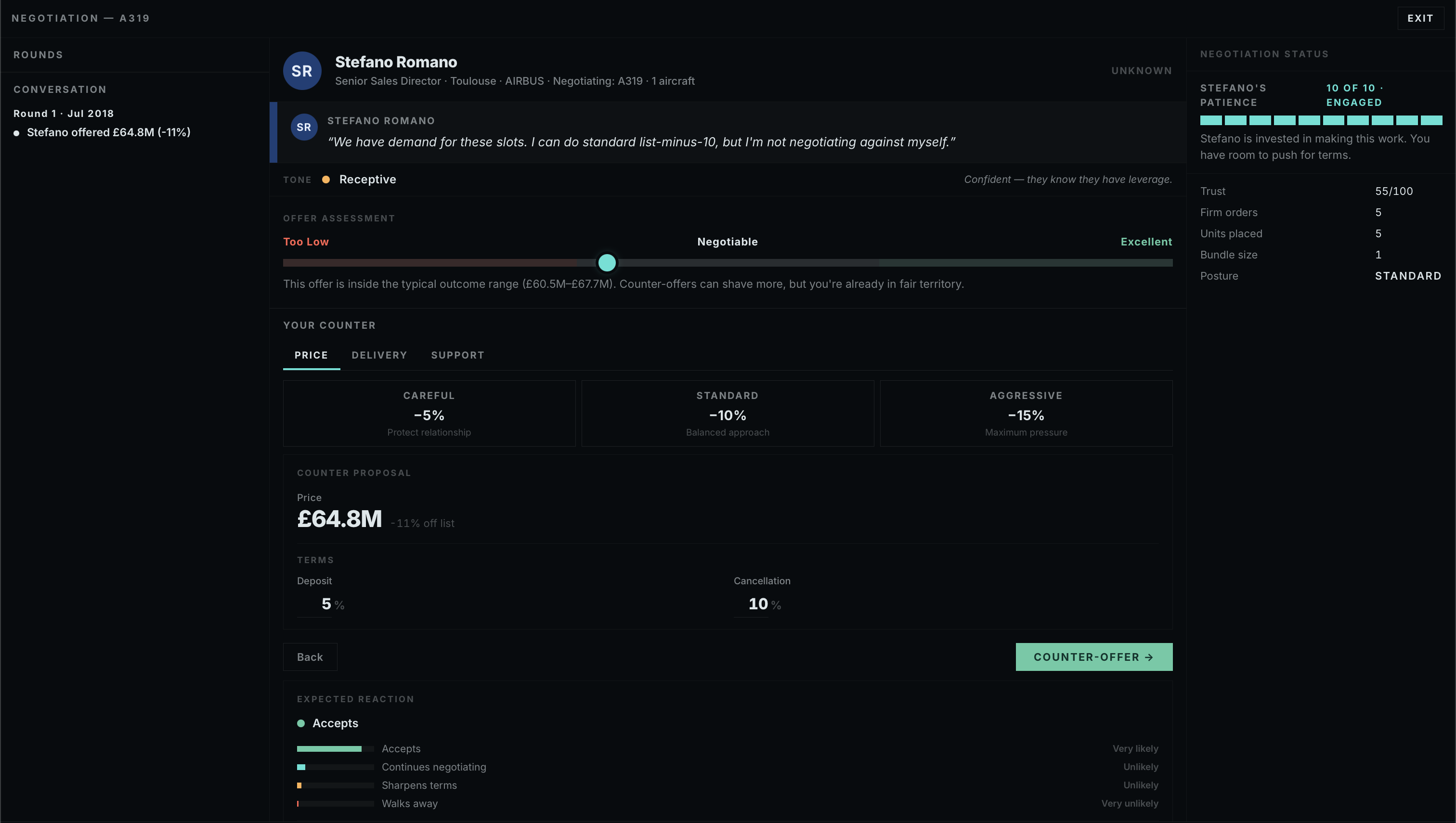
The turn-based negotiation flow (trust, moods, named reps, all still there) got a full visual and informational overhaul:
- Executive header and deal sheet. The whole deal on one surface, tabs renamed to Price / Delivery / Support.
- Strategy presets with plain-language descriptions, an animated assessment bar, and an outcome-based reaction preview, so you can read the rep before you push.
- Assessment as judgment, not numbers. Verdict, advice lines, and confidence expressed as a band, in a Bloomberg-memo register.
- Financing impact, finally surfaced. On an agreed deal you now see what the relationship is worth as a financial asset: tier-adjusted APR, reduced down payment against the 20% standard, estimated loan-life savings, investment-grade status, and EETC eligibility. The engine always computed these. Now you see them where the decision happens.
Financing step v2 · the capital-strategy selector
Downstream of every deal, step 3 of the order wizard was rebuilt from four static text cards into a two-phase capital-strategy selector:
- Phase A. A strategy rail (cash, loan, finance lease, operating lease, sale-leaseback, each with a headline number and one-word trade-off) driving a live dashboard: headline numbers, an ownership timeline, and flexibility meters. Hover a strategy to ghost-preview its numbers, click to commit.
- Phase B. Pick your counterparty from lessor roster cards, with the chosen strategy collapsed to a summary strip. Everything shown is derived from real engine data. No invented approval odds.
It all feeds the News
Delivery-slot opportunities (a customer cancellation opening early slots, a rate increase, a manufacturer promotion, a fleet-replacement campaign) are now grounded in the live production backlog and surface in the News feed the moment they appear, alongside strikes, programme slips, EIS milestones, and rival orders from the wire. The manufacturer world and the news cycle are the same system.
What we want feedback on
This system is two weeks old and playtest feedback will shape its tuning directly:
- Slot gating legibility. When you cannot reach a slot, is it clear why and what would change it?
- Standing progression pace. Does climbing Customer → Preferred → Strategic feel earned or grindy?
- Catalog phase gating. Do the programme badges and the “not yet” and “no longer orderable” states read clearly, or does it feel like the catalog is hiding aircraft?
- The dossier. Does the Partners tab feel like a relationship you are managing, or still like a stats page?
- The wire. Signal or noise? Which event kinds do you actually read?
- Invitations. Frequency, expiry window, and whether the rewards feel worth the click.
- Negotiation assessment. Does the verdict and advice band help you decide when to push?
- Financing v2. Can you tell the four strategies apart in one glance now?
Drop it in the playtest feedback channel on Discord. Screenshots and save files welcome.
Timeline recap
| Date | What happens |
|---|---|
| 17 July 2026 | Playtest opens for registered founding members |
| 17 August 2026 | Playtest closes |
| Christmas 2026 | Early Access target |
Founding members: if you have not claimed your Steam key, register before 17 July. This is the last Road to playtest devlog before the window opens. See you on the factory floor.